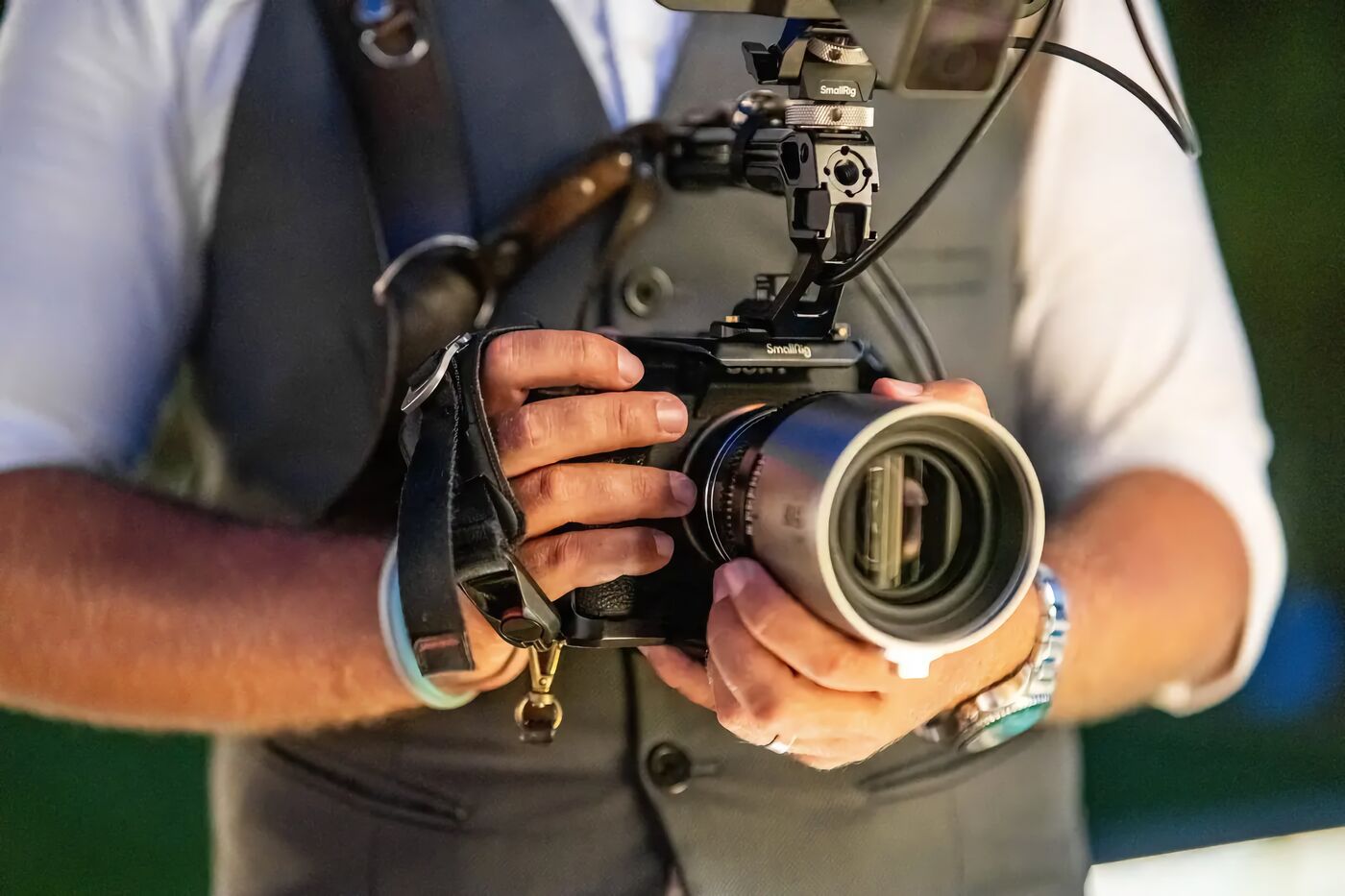
If you've watched one of my films and wondered why it "looks like a real movie" — why candle lights stretch into golden streaks, why the background behind the bride melts into soft ovals, why the frame is wider than a normal video — the answer, in good part, lies in a piece of glass. I film weddings with anamorphic lenses: the same family of optics behind much of the cinema we love. This matters especially if you're planning your wedding in Italy from abroad and comparing videographers by their look: this look has a technical reason, and it cannot be faked well.
What an anamorphic lens is, in plain words
A traditional ("spherical") lens projects the image onto the sensor as it is. An anamorphic lens compresses it laterally while filming: it captures a wider field of view by "squeezing" it onto the sensor. In editing, the image is stretched back out — and the result is that wide, cinematic frame you recognize from every film in a movie theater. It's not a crop, nor an effect added afterwards: it's the physics of glass, the same technique born in Hollywood in the 1950s for CinemaScope.
But the wide format is only the beginning. Optical compression carries visual "signatures" that post-production can't truly replicate: out-of-focus points of light become ovals instead of circles; backlights generate horizontal flares — those streaks of light crossing the frame; and the background separates from the subject in a softer, almost painterly way. You've seen that streak a thousand times at the cinema: the blue flare crossing the screen in J.J. Abrams' Star Trek, the golden blade cutting the sunsets of La La Land — shot entirely anamorphic precisely to honor classic CinemaScope musicals — and the glow stretching the night lights of Blade Runner.
How glass "bends" light
How can a lens compress the image only horizontally? The secret is refraction: when light passes from one medium to another — air to glass and back — it changes speed, and therefore direction. It's the same phenomenon that makes a straw look broken in a glass of water. An anamorphic lens adds cylindrical elements that bend light more strongly along one axis: billions of rays, redirected in an orderly way, drawing a wider world onto the same sensor.
My lenses — and what changes in your film
I shoot with Blazar Remus 1.5x anamorphic lenses. Concretely, in your wedding film this means: a wider frame that embraces an Italian church or a coastal panorama whole; candle and fairy lights that bloom into golden streaks during evening dances; a gentle, dreamlike separation between you and the background in the close moments. It's the difference between an image that documents and an image that feels like memory — which is exactly how emotion behaves.
The flip side (there's always one)
Anamorphic lenses are demanding: heavier, manual, less forgiving, and they ask more of the camera behind them. They force you to work with intention — every frame is a choice, not an accident. It's also why I paired them with a camera system I trust completely: I've told that story in a separate article.
If you want to see what all this physics turns into when it meets a real wedding day, the portfolio is right here. The light of cinema, with your voices inside.
“Your wedding, with the light of cinema.”
Tell me about your day — check my availability