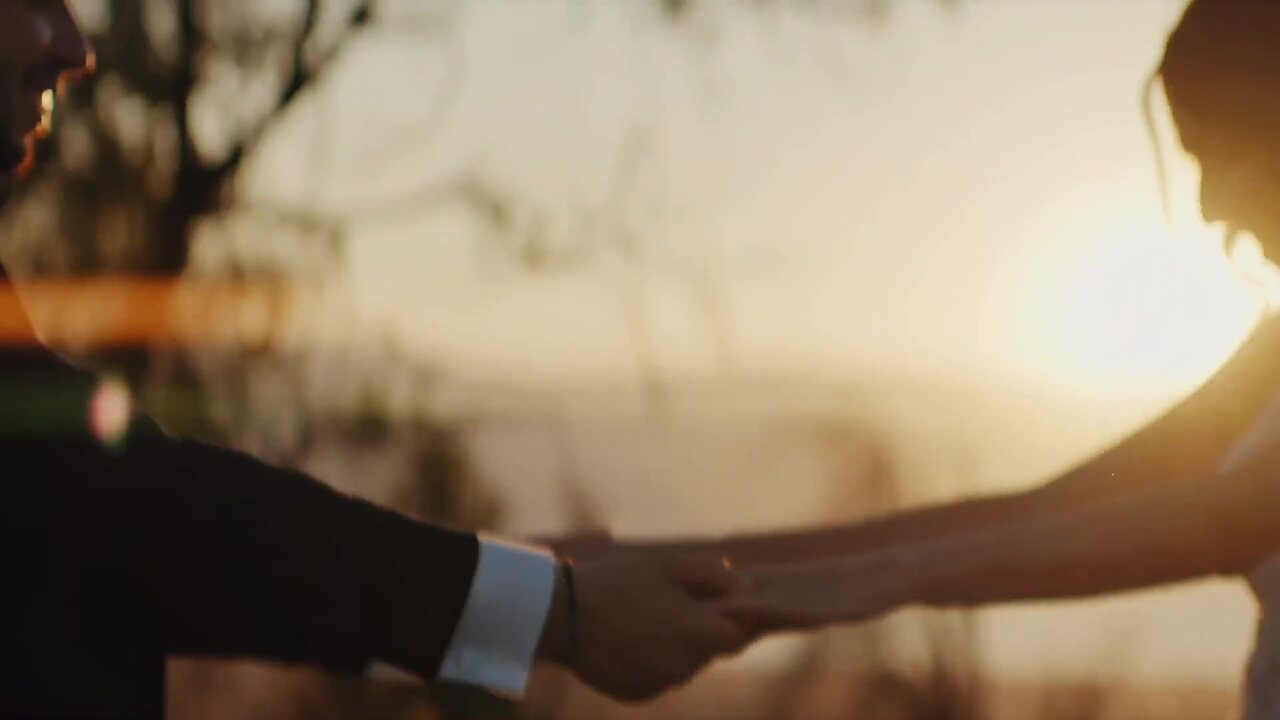
I can see Sicily from home. My studio is in Reggio Calabria, on the Calabrian side of the Strait of Messina, and the island is the thing on the other side of the water — close enough that the lights of Messina are part of the view. The ferry takes about twenty minutes. Taormina is under two hours from my door, crossing included.
So this is not a page about traveling somewhere. It's a page about the coast I grew up looking at.

Taormina faces the sunrise, not the sunset
This is the single most useful thing I can tell you about filming here, and almost nobody says it out loud.
Taormina sits on a terrace a couple of hundred meters above the sea, on the east coast of Sicily. That means the sun comes up out of the water and goes down behind the mountain at your back. If you are picturing the two of you against a sun sinking into the Ionian, from a Taormina terrace, it will not happen — the sun leaves that side of the island early, dropping behind the hills while the sky is still bright.
What you get instead is better than people expect, but it has to be planned for. In the last part of the afternoon the light comes in low and warm from behind the town, and the sea below turns a deep flat blue rather than gold. Then, for maybe twenty minutes after the sun has gone, the whole east coast sits in an even pink afterglow with no hard shadows anywhere — the softest light of the entire day, and the reason I will ask you to keep a slot free at a time that sounds too late to be useful. And if you want backlight, real backlight with flare through it, we take it in the morning, when the sun is coming off the water. On this coast the beautiful hour is at the start of the day, not the end.
Tell me your date and I'll give you the actual clock times rather than a general idea.
The town is a staircase, and the main street has no cars in it
Taormina is gorgeous and physically awkward, and the awkwardness lands on your timeline. Corso Umberto, the street running through the middle of it, is pedestrian. Cars stop at the car parks on the edge of town and everything after that happens on foot, through gates, up and down steps, in and out of alleys that are two meters wide. The cable car down to the beach at Mazzarò and Isola Bella is a lovely shot and a genuine bottleneck — it holds a small number of people at a time, and a wedding party crossing it is not a five-minute event.
None of that is a problem if it's known in advance. It is a serious problem if the schedule was written by someone looking at a map. When I scout the day before I walk the actual route, on foot, at the hour you'll be walking it, and time it. Then we build the day on real numbers.
The Teatro Antico is the image everyone arrives with: broken Roman brick, the sea through the arch, Etna behind it. It's genuinely as good as it looks. It also has opening hours, ticketing, other visitors and its own rules about what a camera can do, and the light through that arch is very different at eleven in the morning than at six in the evening. If it matters to you, it gets planned first and the rest of the day is arranged around it.
Etna, which is both the best background in Italy and a travel risk
From this side of the island the volcano sits inland to the south-west, and on a clear evening it catches the last light long after the town below has gone into shade — a pink cone above a blue coast. It's a frame you cannot get anywhere else in Europe.
It's also an active volcano, and I'd rather be the one who mentions it. A few times a year an ash plume closes Catania airport for a matter of hours. It is not a reason to change your plans and I'm not going to dramatize it. It is a reason for your guests to fly in with a day in hand rather than the same morning, and a reason to know that Palermo and Comiso exist as alternatives. That's all. Advice you can use, not a warning.
Noto, Ragusa Ibla, Modica, Ortigia — the honey-colored south east
The baroque towns of the Val di Noto are made of a soft limestone that behaves unlike any other stone in Italy in front of a camera. At midday it is close to white and it glares: hard contrast, blown highlights, squinting faces. In the last two hours of the day the same stone turns a deep warm honey, and a bride on the cathedral steps at Noto in that light needs no help from anybody. The stone does the work.
The same is true of Ortigia, the island heart of Siracusa. Piazza Duomo is an enormous white room with no roof. Beautiful, and at one in the afternoon it is a genuinely difficult place to film a human face well.
One practical warning about this region, because couples get it wrong constantly: Sicily is big. Taormina to Noto is a little over two hours of driving, each way. Palermo to Taormina is about three. If your ceremony is in one of these towns and your reception is in another, that is not a transfer, it is a road trip, and it will eat the exact hour of light I've just asked you to protect. I would much rather work this out with you a year early than discover it on the day.
And if you're on the other side of the island
Everything above flips. The north-west coast — around Palermo, out towards Trapani and San Vito lo Capo — is the side where the sun goes down into the water. That's where a sea sunset actually lives in Sicily. Different island, same job, opposite clock. If your venue is over there, the timeline I'd propose looks nothing like a Taormina one, and that difference is the whole reason this page exists.
Churches here have an audio problem, not a picture problem
A Sicilian church is often a tall stone box with a vaulted ceiling and a marble floor, and it will hold a voice in the air for a long time after the voice has stopped. Vows recorded on a camera microphone from ten meters back, in a room like that, come out as a wash. It is the most common way a wedding film loses the only words that mattered.
So the audio is never left to the camera. A discreet transmitter, a recorder near the altar, everything captured on separate tracks in 32-bit float so that a whisper and a sung response can both survive in the same recording. You will never see any of this, which is the point. You will hear it.
Where I'm based, and why here it's simply an advantage
My studio is in Reggio Calabria, twenty minutes of water from Messina. For Sicily that means no flights to arrange, no hotel logic, no crew arriving tired: I drive to the ferry, cross, and I'm there. It also means I can come the day before without it being a production, stand at your venue at the hour your ceremony will happen, and watch what the light actually does — which on this coast, where the sun goes down behind a mountain, is worth more than any amount of research.
Over 500 wedding stories told, a documentary approach, and a scout the evening before. That's the method, and on this island it costs me a ferry ticket.
I don't follow trends. I follow what's actually happening in the room.
Every season, wedding films pick up a new look. A color grade everyone copies. A transition everyone uses. A drone move that was startling once and is now on every second film. Three years later those films look dated, and the strange part is that the couple inside them hasn't aged at all — only the fashion wrapped around them has.
I've never been interested in that. What I look for is the emotion in the room, and emotion doesn't go out of style. The second before the doors open. Your father's face when he understands it's actually happening. The two of you at the end of the night, when nobody is filming anymore — except I am.
It also means being honest about who I'm right for. If what you want is the film that looks like the one trending this year, there are people who do that very well and I'll say so happily. My films are for couples who will put it on in fifteen years and feel the same thing in their chest as they did that day. That's a different job, and it's the only one I know how to do.
What you actually receive
A complete 15–20 minute film in 4K Ultra HD, shot with anamorphic cinema lenses, drone coverage where it is permitted, and multi-track live audio recorded in 32-bit float. Documentary approach throughout: no forced poses, no interrupting a moment to repeat it, nothing staged for the camera. If you want your guests to relive the day during the reception itself, a Same Day Edit trailer can be delivered that evening. You can see how different places become different films in the portfolio.
Films made this way took the Grand Award at Filmmaker Global 2024 in Athens, and Best Short Film at the ANV Film Festival in 2025. I'll mention it once and leave it there: it says something about how I work, and nothing yet about your day — which is the part that actually matters.
Planning it from abroad
Most of the couples I film plan their Italian wedding from another country. For the east coast and Taormina the airport is Catania; for the south east, Comiso is often closer than people realize; for the north and west it's Palermo. From there it is straightforward: we meet on a video call, everything is set out in a clear written contract, and I coordinate directly with your planner and your photographer — who I will have spoken to before the day, because a videographer and a photographer who haven't met are two people standing in each other's shots.
Enquiries are welcome in English, by contact form, email or WhatsApp. If you're comparing suppliers from a distance, I've written honestly about how to choose a wedding videographer in Italy and about what a wedding film really costs.
When to marry in Sicily
May, early June, and the whole of September into mid October. The island stays warm long after the rest of Europe has given up, and October light here is exceptional — low, clean, and long. July and August are a different proposition: it is genuinely hot, the scirocco can arrive from Africa and put a white haze over everything including your view of Etna, and an outdoor ceremony at four in the afternoon in August is a real endurance test for your guests before it is a filming problem. If that's your date, the timeline is the first conversation we have.
Frequently asked questions
Do you film weddings in Sicily?
Yes, regularly — my studio is in Reggio Calabria, directly across the Strait of Messina, so Sicily is about as close to home as it gets. Taormina is under two hours from my door with the ferry crossing included.
Can we have a sunset over the sea in Taormina?
Not from the town itself: Taormina faces east, so the sun rises out of the sea and sets behind the mountain. What you can have is the low warm light of late afternoon, the pink afterglow for about twenty minutes after the sun has gone, and real backlight over the water in the morning. The north-west coast, around Trapani, is where Sicily's sea sunsets are.
Can you fly a drone in Taormina or at the Teatro Antico?
Over open coast and countryside, often yes. Over the historic center and at protected monuments, no — or only with permission arranged well in advance. I check the specific zone for your venue before the day and tell you honestly what is possible instead of promising an aerial I can't legally take.
Which airport should our guests use?
Catania for Taormina and the east coast, Comiso for Noto, Ragusa and Modica, Palermo for the north and west. Because Catania sits under Etna and can close briefly for volcanic ash, I'd suggest arriving a day early rather than on the morning of the wedding.
Our ceremony and reception are in different towns. Is that a problem?
It's a problem only if the driving time isn't in the plan. Distances on this island are bigger than they look — Taormina to Noto is over two hours each way. Tell me both venues and I'll tell you what it costs you in light.
How far in advance should we book?
I deliberately take on a limited number of weddings each year, and Sicilian Saturdays in June, September and early October go early. Write as soon as you have a date and a venue.
The other places couples ask me about
Sicily tends to be compared with the mainland south, or with the two names everyone knows. Here is the practical difference.
- Wedding videographer on Lake Como — the mountain shadow that arrives an hour early, arriving by boat, Bellagio and Varenna.
- Wedding videographer in Tuscany & Florence — villa timelines, the last hour of light over the hills, Val d’Orcia and Chianti.
- Wedding videographer on the Amalfi Coast — Ravello, Positano and Amalfi, the traffic on the SS163, and why distance here is measured in staircases.
- Wedding videographer in Puglia — masserie whose whitewashed walls light the whole day, Ostuni, the Valle d’Itria and Salento.
- Wedding videographer in Tropea & Calabria — my own coast: Tropea, Capo Vaticano, the Costa degli Dei and Scilla.
Marrying somewhere else in Italy — Venice, Rome, Umbria, Lake Garda, the Dolomites? My page on filming weddings across Italy explains how I work when the wedding is far from home, which is most of the time.
Want your film screened before the night is over? See how a same day edit works at an Italian wedding.
“Sicily is the view from my window. Twenty minutes of water, and I'm at work.”
Check my availability for your date