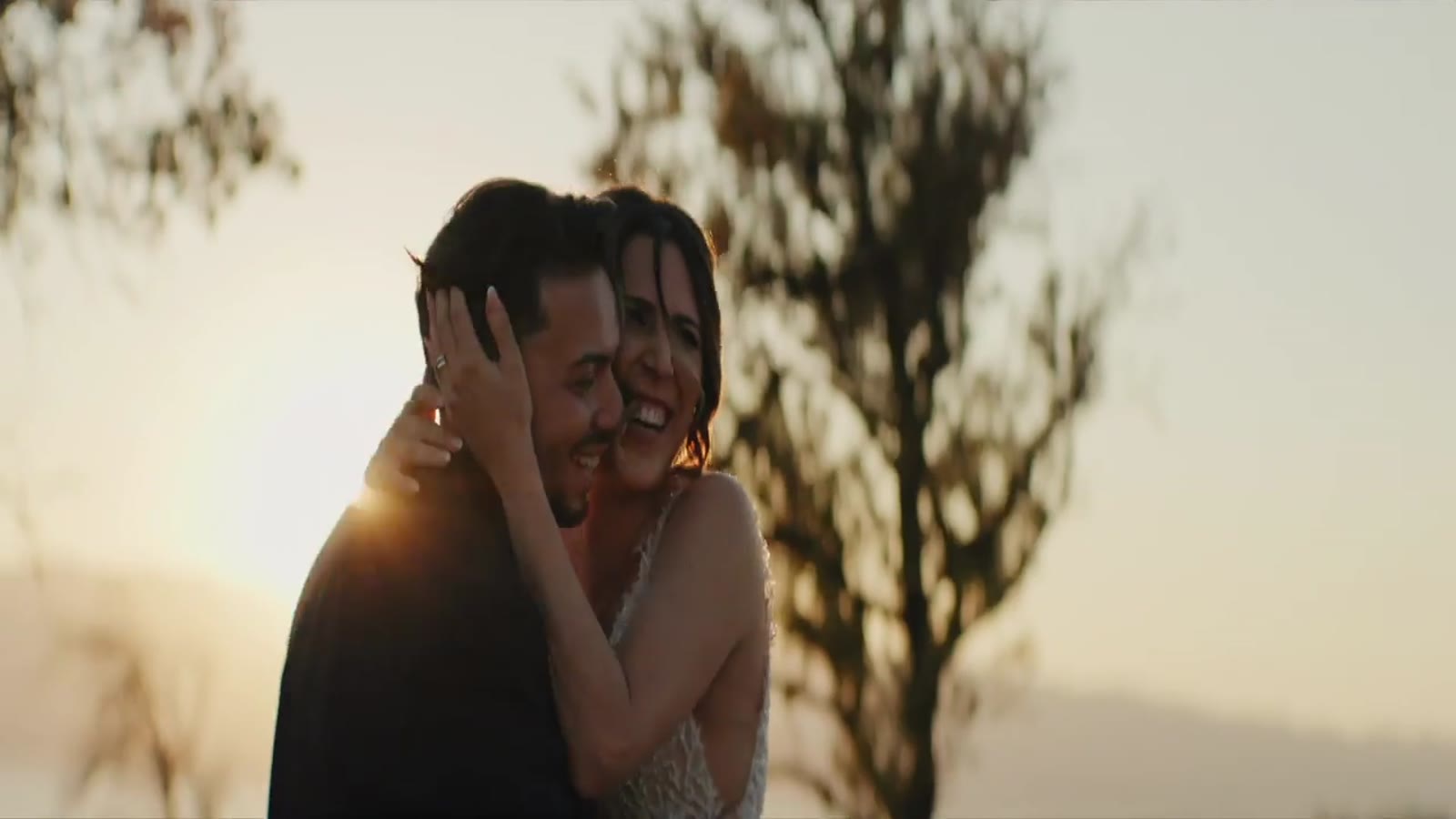
Lake Como is the only place in Italy where I would plan a wedding film around a boat timetable and a mountain shadow before I thought about anything else.
Both of those are geography, not preference. The lake is a narrow trench with steep mountains on either side, which means the sun does not set here — it disappears behind a ridge, often more than an hour before it actually goes down, and much earlier than couples expect. On some shores in late September the light leaves the terrace while the aperitivo is still being poured. If your film is supposed to have the lake glowing in it, that hour is not negotiable and it is not the hour the app tells you.
The shadow line, and why it decides your timeline
Villas on the western shore around Tremezzina and Lenno look east across the water: they catch beautiful early light and lose the sun first. Villas on the eastern side around Bellagio, Varenna and Menaggio hold the evening light on their facades much longer, but their mornings are cooler and flatter. It is the same lake and two completely different films.
So when a couple sends me a venue name, the first thing I work out is which way it faces and where the ridge is on their date. Then I can tell them something useful: keep the couple's twenty minutes at this time, not that one. Nobody enjoys being told their schedule is wrong six months out. Everybody prefers it to being told on the day that the light has gone.
Arriving by boat — the shot everybody wants, and what it costs
The classic Como image is a bride arriving at a villa by water. It is genuinely as good as it looks, and it is the single most rigid element of the day.
A boat arrival has a fixed departure, a fixed crossing time, and no ability to go round again. To film it properly you need two positions at once: one on the water with the couple, one already waiting at the dock. That means either a second camera operator or a decision, in advance, about which of those two shots you are giving up. I would much rather have that conversation with you in March than improvise it while a taxi boat is pulling away.
The lake also makes its own weather. A breeze comes up across the water on most afternoons, reliably enough that locals have a name for it. It is lovely on a hot day and it is a problem for two things: a drone over open water, and a microphone at an outdoor ceremony. Which is why the vows are recorded on their own audio tracks and never left to a camera microphone hoping for the best.
Bellagio, Varenna, and the villas
The names couples arrive with are Bellagio, Varenna, Tremezzo, Menaggio, Cernobbio, Como itself. What they have in common is that they are vertical and narrow: stepped lanes, stone stairways, walled gardens on terraces above the water, and almost nowhere for a car to wait. Getting a bride from a hotel room to a ceremony can involve more stairs than road, and stairs in a long dress take the time they take.
The gardens are the reward. Formal terraces, cypress and lemon, statuary, hedges cut into frames, and behind all of it a wall of mountains falling into water — the reason this lake has been filmed for a century. Reflected light coming up off the water fills faces from below in a way you get almost nowhere else, and it is extremely flattering if you know it's there and expose for it.
One honest warning about drones: much of the lake is not open airspace, and several of the famous villas do not permit flight at all regardless of the law. I check the zone and the venue rules before your day and tell you what is actually possible, rather than selling you an aerial shot I can't legally deliver.
Where I'm based, and why it doesn't hold your day back
My studio is in Reggio Calabria, at the far southern end of Italy, and Como is a day's travel from it. I'd rather tell you that than have you discover it: most of my year is spent away from home, filming in other regions. Travel isn't an extra in this job — it is the job.
What makes a traveling videographer work or fail is never the distance. It's whether he arrives prepared. I come the day before, on site, at the hour your ceremony will actually happen, and I walk the place with a camera in my hand and no wedding in the way — so that on your day I already know where to stand and which way the light is going. Over 500 wedding stories told, a documentary approach that doesn't depend on knowing one venue by heart, and that scout the evening before: that is the whole method, and it travels.
On a lake where the sun disappears behind a mountain instead of setting, that evening scout is worth more than a map. There are good videographers living on these shores too, and if one of them is right for you, good. Just don't choose on distance alone — watch the films.
I don't follow trends. I follow what's actually happening in the room.
Every season, wedding films pick up a new look. A color grade everyone copies. A transition everyone uses. A drone move that was startling once and is now on every second film. Three years later those films look dated, and the strange part is that the couple inside them hasn't aged at all — only the fashion wrapped around them has.
I've never been interested in that. What I look for is the emotion in the room, and emotion doesn't go out of style. The second before the doors open. Your mother's face when she understands it's actually happening. The two of you at the end of the night, when nobody is filming anymore — except I am.
Como is a place that tempts a filmmaker into making the location the subject. It isn't. You are. The lake is the most beautiful supporting actor in Italy, and it should stay in that role.
What you actually receive
A complete 15–20 minute film in 4K Ultra HD, shot with anamorphic cinema lenses, drone coverage where it is permitted, and multi-track live audio recorded in 32-bit float. No forced poses, no interrupting a moment to repeat it, nothing staged for the camera. A Same Day Edit trailer, delivered during the reception, is available as an option. You can see how different places become different films in the portfolio.
Films made this way took the Grand Award at Filmmaker Global 2024 in Athens, and Best Short Film at the ANV Film Festival in 2025. I'll mention it once and leave it there: it says something about how I work, and nothing yet about your day.
Planning it from abroad
Milan Malpensa is the usual arrival for international guests, a little over an hour from the lake; Bergamo and Linate are often cheaper and just as workable; and there is a direct train from Milan to Varenna, which is genuinely the easiest way for guests without a car. Once travel is settled, the rest is simple: a video call, a clear written contract, and direct coordination with your planner and photographer before the day — because a videographer and a photographer who haven't spoken are two people standing in each other's shots.
Enquiries are welcome in English by contact form, email or WhatsApp. If you're comparing vendors from abroad, I've written honestly about how to choose a wedding videographer in Italy and what a wedding film really costs.
When to marry on the lake
June and early July, then the first three weeks of September. May is beautiful and genuinely wetter than couples expect — the mountains hold cloud. October gives you the best color on the hillsides and the earliest shadow of the season, which is a real trade-off and one I'd rather discuss than discover. August is warm and very full.
Frequently asked questions
Do you film weddings on Lake Como?
Yes. My studio is in Reggio Calabria and I travel for weddings across the whole country. I arrive the day before and scout your venue at the hour of your ceremony, so I'm not learning the place while you're getting married in it.
Which airport should our guests fly into?
Milan Malpensa is the main one, roughly an hour and a quarter away. Bergamo and Linate are good alternatives, and the Milan–Varenna train is the easiest option for guests without a car.
Can you fly a drone over the lake?
Sometimes, and it depends entirely on the exact spot and the venue's own rules — several of the famous villas don't allow it at all. I check both before your day and tell you honestly what's possible instead of promising an aerial I can't legally take.
We're arriving by boat. Can you film that properly?
Yes, and it's worth planning early: a boat arrival happens once, on the boat's schedule, and covering it properly means having a camera on the water and another already at the dock. Tell me early and we'll build the day around it.
How far in advance should we book?
I deliberately take on a limited number of weddings each year, and Como Saturdays in June and September are reserved a long way out. Write as soon as you have a date and a venue.
The other places couples ask me about
Como is often weighed against a villa in the hills or a terrace over the sea. If you’re still deciding, here is what changes.
- Wedding videographer in Tuscany & Florence — villa timelines, the last hour of light over the hills, Val d’Orcia and Chianti.
- Wedding videographer on the Amalfi Coast — Ravello, Positano and Amalfi, the traffic on the SS163, and why distance here is measured in staircases.
- Wedding videographer in Puglia — masserie whose whitewashed walls light the whole day, Ostuni, the Valle d’Itria and Salento.
- Wedding videographer in Tropea & Calabria — my own coast: Tropea, Capo Vaticano, the Costa degli Dei and Scilla.
- Wedding videographer in Sicily & Taormina — Taormina facing the sunrise instead of the sunset, Etna behind the ceremony, the baroque of Noto and Ortigia.
Marrying somewhere else in Italy — Venice, Rome, Umbria, Lake Garda, the Dolomites? My page on filming weddings across Italy explains how I work when the wedding is far from home, which is most of the time.
Want your film screened before the night is over? See how a same day edit works at an Italian wedding.
“On this lake the sun doesn't set. It goes behind a mountain, an hour early, and it doesn't wait.”
Check my availability for your date